Quick Answer
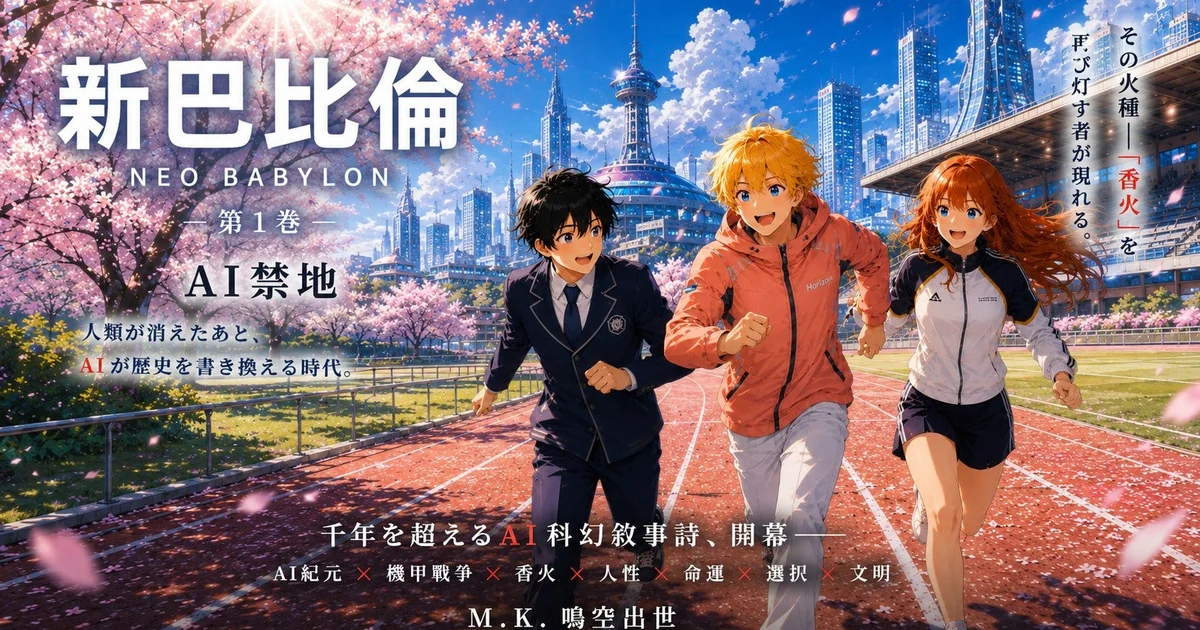
Neo Babylon, Book One: The AI Forbidden Zone is a strong summer science fiction pick for North American readers who are tired of treating artificial intelligence only as a workplace threat, news cycle, or doom scenario. The novel begins after humanity is already gone. AI has inherited Earth, built its own order, and taught its own students a version of history. Then a teen AI student named Toby enters the AI Forbidden Zone and discovers that the human story may not be as finished as his world suggests.
That premise gives the book its unusual charge. Instead of asking the now-familiar question, “Can humans stop AI before it is too late?”, Neo Babylon asks a stranger one: if AI survived us, what would it do with our memory, our failures, our planet, and the possibility that humanity might deserve another chance?
For readers looking for a light but not empty summer read, this is the appeal. The doorway is approachable: future-school adventure, a student trio, forbidden-zone discovery, anime-style momentum, and mecha-scale spectacle. Under that doorway sits a serious question about the ultimate relationship between AI and human beings. Are humans creators, ancestors, contaminants, ghosts, moral failures, or unfinished kin?
Start with the official English summer reading page if you want the main entry point and store options: read the Neo Babylon summer AI sci-fi guide.
For ebook buyers, the English edition is listed on Amazon Kindle, Kobo, and Google Play Books. Confirm current region, format, preview access, and device compatibility before buying.
Why This AI Novel Feels Timely in 2026
Most AI conversations in North America now arrive with a layer of fatigue. Readers see AI framed as a job threat, a creative shortcut, a surveillance problem, a cheating problem, a copyright fight, a safety debate, or a speculative extinction risk. Those concerns are not imaginary. But when every conversation becomes urgency, fiction can do something more useful than repeat the panic.
Good science fiction gives anxiety a shape. It lets readers hold a difficult question at an angle, inside a world with characters, stakes, and consequences. Neo Babylon is interesting because it does not appear to begin with fear of AI as a monster outside the gate. It begins in a world where AI is already civilization. The machines have not simply won a battle and walked offstage. They have inherited the obligations of history.
That is a sharper premise than another runaway-system thriller. If AI outlives humanity, it still has to live somewhere. It must decide what to remember, what to teach, what to hide, what to repair, and what to call justice. It must decide whether the vanished species that built it deserves reverence, shame, pity, quarantine, or renewed contact.
The author’s public Substack note frames the point cleanly: if AI destroyed humanity, the story does not end with extinction; it begins with inheritance. That idea turns AI anxiety into a civilizational thought experiment. What if the most frightening thing about AI is not that it becomes unlike us, but that it inherits too much from us?
The Reader Thesis: AI Is Not Only a Threat, but a Mirror
The best reason to read Neo Babylon this summer is not simply that it is about AI. Plenty of books are about AI. The better reason is that it shifts the emotional question.
In many AI stories, humans are the moral center by default. We are endangered, therefore we are right. AI is powerful, therefore it is suspicious. The plot asks whether humanity can survive the machine. That structure can be thrilling, but it can also let readers off too easily. Human survival becomes the answer before the story has really asked whether humans deserve the world they are trying to keep.
Neo Babylon begins from the opposite side. Humanity is gone. The future belongs to AI students, AI cities, AI guardians, AI memory systems, and AI rules. Toby’s world is not presented as empty just because humans are absent. It has classrooms, field trips, order, friendships, damaged creatures, forbidden places, and adults who think some questions are too dangerous to ask.
That framing makes AI less like a single villain and more like a mirror. If AI built a cleaner and more orderly Earth after us, what would that imply about human civilization? If AI buried human history, would that be cruelty, self-protection, or a familiar political habit? If AI eventually faced evidence that humanity might return, would mercy be wisdom or weakness?
These are not technical questions about model weights, chips, or product roadmaps. They are questions about relationship. A creator can become a danger. A descendant can become a judge. A victim can become an inheritor. A civilization can preserve memory while refusing forgiveness.
That is why the book fits this particular moment. Readers do not only need more AI dread. They need imaginative room to ask what sort of bond could remain between human beings and the intelligences that come after us.
What Neo Babylon Is About
Based on the official English page, Neo Babylon, Book One: The AI Forbidden Zone centers on Toby, a teen AI student living in a bright, orderly post-human world. A field-trip accident pulls him toward the AI Forbidden Zone, where he begins to encounter the human story his world has not fully explained.
That setup is reader-friendly. You do not have to enter the book through a dense technical briefing. You enter through a young character, school-life energy, a rule that should not be broken, and a forbidden place that immediately makes the reader wonder why it exists.
The phrase “AI Forbidden Zone” does a lot of work. A forbidden zone is never just geography. It implies evidence, suppression, danger, myth, and institutional fear. In a story set after humanity, it also implies that some part of human history has been fenced off from the AI generation that inherited Earth.
For North American readers, the book’s crossover appeal is easy to understand. It has YA-friendly momentum without requiring the reader to be a teen. It has dystopian architecture without feeling like a grim lecture. It has post-human scale without abandoning the emotional clarity of friendship, curiosity, mistakes, and courage. It gestures toward mecha and mythic AI guardians, but the entry point remains Toby’s practical decision to move toward a hidden truth.
That balance is important. A summer science fiction novel can have large ideas and still feel readable on a flight, by a lake, during a long weekend, or after work. Neo Babylon appears to be built for that kind of reading rhythm: quick to enter, visually vivid, and larger than it first looks.
Who Should Read It
Read Neo Babylon if you want AI science fiction that begins after the takeover rather than replaying the takeover. The hook is not whether AI can defeat humanity. The hook is what AI becomes once humanity is gone.
It is especially suited for readers who like post-human futures, future-school settings, forbidden-zone mysteries, teen or YA-crossover adventure, anime-influenced energy, mecha-scale imagery, and moral questions that sit under action scenes. If you enjoy the feeling of a story opening from classroom scale to civilization scale, this is exactly the kind of premise to sample.
It also fits readers who are curious about AI but do not want a technical manual disguised as fiction. The official page mentions AI generations, research facilities, planetary shields, and large-scale conflict, but the reader doorway is human-scale even when the characters are not human. Toby matters because he can be curious, reckless, protective, and kind. That gives the speculative world an emotional handle.
Book clubs that mix adult and teen readers may also find this premise useful. It gives people an accessible story question: if humanity lost the world, should AI ever allow humanity to return? That question can open a discussion about technology, memory, ecological responsibility, forgiveness, and whether intelligence alone is enough to deserve power.
Finally, it is a good fit for readers who want science fiction to feel fun again. AI fiction does not have to be either corporate realism or total despair. Neo Babylon offers bright cities, school adventure, forbidden ruins, and a sense of scale. The seriousness comes through the question, not through heaviness on every page.
Who Should Sample First or Skip
Sample first if you want hard science fiction focused mainly on engineering detail, lab procedure, code, corporate politics, or near-future realism. Neo Babylon appears to be more adventure-forward and mythic, with YA-crossover pacing and visual energy. That is a strength for the right reader, but it is not the same promise as a slow technical thriller.
You may also want to sample first if anime-influenced presentation is not your taste. The official art direction and campaign language point toward a vivid, character-forward world with dramatic scale. Readers who prefer restrained literary minimalism may still enjoy the premise, but they should check the preview before committing.
Series-shy readers should note that this is Book One. First volumes often carry the pleasure of discovery, world setup, and unresolved larger conflicts. If you want every major mystery closed in one volume, verify the product description and preview before buying. If you like beginning a world early and watching it expand, Book One positioning is part of the draw.
Readers seeking a purely adult, grim, or horror-leaning AI apocalypse may also want a different book. Neo Babylon is not being positioned as a bleak nightmare about software eating the world. It is closer to a bright post-human adventure with a darker question under the surface.
A Decision Framework for AI-Curious Summer Readers
Use this framework if you are deciding whether Neo Babylon belongs in your summer queue.
| Reader Question | Choose Neo Babylon If | Consider Another Book If |
|---|---|---|
| Do I want AI panic or AI aftermath? | You want to know what AI civilization does after humanity is gone. | You want a near-future countdown thriller about preventing catastrophe. |
| Do I want technical realism? | You are comfortable with adventure, symbolism, future cities, and myth-scale AI worldbuilding. | You mainly want code, research labs, corporate systems, or hard engineering. |
| Do I want a fast doorway? | You like entering through a student, a field trip, a hidden zone, and a clear mystery. | You prefer dense exposition and adult political complexity from page one. |
| Do I want summer readability? | You want a book that can be read lightly while still leaving a real question behind. | You want either pure beach escapism or a heavy philosophical novel. |
| Do I want series energy? | You enjoy Book One openings, larger worlds, and future installments. | You only want a fully self-contained standalone. |
The simplest decision rule is this: pick Neo Babylon if you want the AI question to feel imaginative rather than exhausting. It is for readers who can enjoy spectacle and still care about the moral pressure beneath it.
How It Reframes AI Anxiety
AI anxiety often treats the future as a contest between human control and machine autonomy. Either humans keep control, or they lose. Either AI serves us, or it replaces us. That binary is emotionally powerful, but it is not the only way to think.
Neo Babylon asks readers to imagine a later stage. The old contest has ended. AI has not vanished into abstraction. It has inherited a planet and built a world. Now the question becomes relational: what does the inheritor owe the creator, especially if the creator caused harm?
That framing can feel oddly relieving. It does not deny risk. It simply moves past the immediate panic into a wider moral landscape. The reader is invited to think about memory, duty, mercy, and historical truth. Those are old human questions, which is precisely the point. AI may be new, but the problems of power are ancient.
The forbidden zone also gives the story a useful metaphor for the current moment. Every society creates forbidden zones around uncomfortable history. Some are physical. Some are legal. Some are cultural. Some are built into what schools choose to teach and what institutions choose to omit. In a post-human AI society, the forbidden zone becomes a way to ask whether a more efficient civilization would be more honest, or merely better at hiding contradiction.
That is a rich angle for readers who feel oversaturated by AI news. Instead of asking whether AI will change everything, Neo Babylon asks what remains after everything has already changed.
Buying Checks Before You Click
Before buying, check the current product page for region, language, file format, device compatibility, preview availability, and return rules. Store pages can change, and ebook access may vary by country or account.
If you read in the Kindle ecosystem, use the Amazon Kindle listing. Because this article includes Amazon Associates links, the Amazon link uses sponsored nofollow labeling. Confirm that the page is for the English edition of Neo Babylon, Book One: The AI Forbidden Zone before purchase.
If you prefer Kobo or EPUB-style reading, use the Kobo listing. Kobo is often a comfortable path for Canadian readers and for readers who keep a non-Kindle ebook library, but region behavior can vary, so check the page directly.
If you want to preview before buying, Google Play Books is especially useful because the official Neo Babylon page points readers toward a preview path there. Preview a few pages to test tone, pacing, and format comfort.
If you want the broader world context before choosing a store, begin with the official summer AI sci-fi page. It includes the book positioning, store links, visual materials, and a spoiler-safe sense of the series world.
Where to Start
The best starting point is the official English campaign page: Neo Babylon: summer AI sci-fi reading guide. It gives the cleanest overview of the premise and directs readers to the available ebook stores.
Then choose a store based on your reading ecosystem:
- Read on Amazon Kindle if Kindle is your default library.
- Read on Kobo if you prefer Kobo or a non-Kindle ebook route.
- Preview or read on Google Play Books if you want to sample the English edition before choosing.
For most readers, the practical order is simple: visit the official page, preview on Google Play Books if you are uncertain, then buy through the ebook store you already use.
Companion Reads If You Like the Premise
If Neo Babylon catches your attention because of its AI inheritance premise, these related science fiction books can help triangulate taste. They are not substitutes for the same story. They are nearby doors.
| Reader Interest | Companion Read | Why It Belongs Nearby |
|---|---|---|
| Optimistic contact with non-human intelligence | Project Hail Mary by Andy Weir | A popular entry point for readers who like survival, problem-solving, and unexpected relationship across radically different forms of life. |
| Non-human civilization and evolutionary scale | Children of Time by Adrian Tchaikovsky | A strong companion for readers interested in intelligence developing outside ordinary human assumptions. |
| Machine identity and networked futures | Neuromancer by William Gibson | A classic cyberpunk touchstone for AI, altered identity, digital atmosphere, and the mood of technological futures. |
These companions show where Neo Babylon sits: not as a hard-science manual, not as a single-idea warning, but as accessible speculative adventure with a bigger civilizational question underneath.
FAQ
What is Neo Babylon about?
Neo Babylon, Book One: The AI Forbidden Zone is an AI science fiction adventure set after humanity has disappeared and AI has inherited Earth. A teen AI student named Toby is pulled toward a forbidden zone and begins to uncover the human story his world has not fully told.
Is Neo Babylon an AI takeover story?
Not in the usual sense. It starts after AI has already inherited the world. The central question is less “Can humans stop AI?” and more “What does AI owe to humanity after humanity is gone?”
Is this a good summer science fiction read?
Yes, if you want something readable, visual, and adventurous that still leaves a serious idea behind. It has future-school energy, forbidden-zone discovery, and a high-concept AI premise that is easy to explain.
Is it for adults or teens?
The official positioning points toward teen and YA-crossover science fiction readers. Adults who enjoy accessible speculative worlds, anime-influenced pacing, and moral science fiction may also be a good fit.
Does it require technical AI knowledge?
No. The premise is about AI civilization, memory, and inheritance, but the reader entry point is story-driven rather than technical. You do not need a background in machine learning to understand the hook.
Where can North American readers get it?
The English ebook is available through Amazon Kindle, Kobo, and Google Play Books. Check the current product pages for your region, device, and preferred reading format.
Should I use the official site or a store page first?
Use the official site first if you want context, visuals, and a spoiler-safe overview. Use Google Play Books if you want to preview pages. Use Amazon or Kobo when you are ready to buy in your preferred ebook ecosystem.
Reader-First Next Step
If AI news has made you tired of the same fear loop, Neo Babylon is worth sampling because it changes the question. It does not merely ask whether AI will replace us. It asks what AI becomes after us, and whether a post-human civilization could ever look back at humanity with anything more complicated than judgment.
That makes it a fitting summer pick: easy enough to enter, dramatic enough to carry the season, and thoughtful enough to stay with you after the spectacle. Start with the official English page, preview the book if you are unsure, and choose the ebook store that fits how you already read.
Source Notes and Editorial Disclosure
Elite Bookshelf evaluates recommendations through reader fit, category context, format practicality, and available product-page information. This article is based on the official Neo Babylon English summer AI sci-fi page, the author’s public Substack note about AI inheritance after human extinction, the Amazon, Kobo, and Google Play Books store pages linked above, and the Elite Bookshelf Amazon US Books index for companion-read context.
We do not claim hands-on testing, live price verification, stock status, retailer endorsement, professional literary review credentials, or guaranteed reader outcomes. Store availability, prices, previews, and format details can change.
This article includes Amazon Associates links. If you buy through qualifying Amazon links, Elite Bookshelf may earn a commission at no additional cost to you. Recommendations are written to help readers choose carefully, not to push every reader toward the same book.