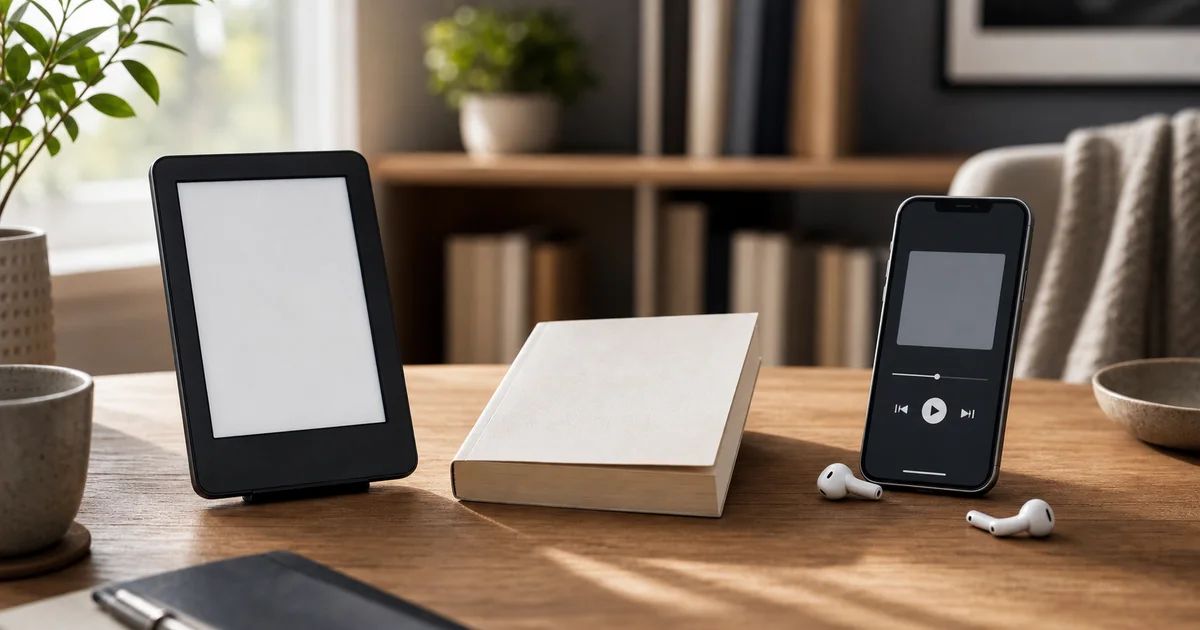
The right book format is the one that lowers friction for the reading you actually do. Kindle is best for portability, search, travel, and quick access. Paperback is best for tactile reading, visual memory, lending, and books you want to keep on a shelf. Audiobook is best for movement, commuting, chores, and memoir or narrative nonfiction where voice adds value.
The mistake is treating format as a personality test. You do not have to be a Kindle person, a print person, or an audio person. Most serious readers eventually use different formats for different jobs. The more useful question is: what kind of attention does this specific book require?
This comparison focuses on buying decisions: when to choose each format, when to avoid it, which book categories are format-sensitive, and what to verify before you pay.
Quick Answer
Choose Kindle for books like Thinking in Systems when you want search, highlights, and portability. Choose paperback for cookbooks, visual reference, and books you want to lend. Choose audio for voice-driven memoir like Greenlights or narrative books you can follow while walking.
For practical nonfiction such as Never Split the Difference, format depends on use. If you will underline and revisit, Kindle or paperback may be better. If you want to absorb examples during a commute, audiobook can work. For fiction like Project Hail Mary, audio may increase momentum if narration style fits your taste.
Why Readers Search For This
Readers search for format advice because format regret is real. A beautiful hardcover may sit unread because it is too heavy for travel. An audiobook may be purchased with good intentions and then become difficult because the book includes diagrams, dense arguments, or names that are easier to track on the page. A Kindle edition may be convenient but less satisfying for a gift or a book meant to live visibly at home.
The common misconception is that one format is generally superior. In practice, the same reader may prefer Kindle for travel, print for cookbooks, and audio for memoir. Format is not only about preference; it is about environment. A parent cooking dinner, a commuter on a train, and a student marking passages need different versions of the reading experience.
What matters is friction. The best format is the one that makes the book more likely to be started, continued, remembered, and used. A cheaper format is not better if you never open it. A premium format is not better if it creates pressure.
How To Choose The Best Format
- Use Kindle when portability, instant access, adjustable text, and highlights matter. It is especially useful for long books, travel, and readers with limited shelf space.
- Use paperback when layout, flipping, lending, marginal notes, or physical memory matters. It is often stronger for cookbooks, illustrated books, poetry, and books you want to hand to someone else.
- Use audiobook when your available reading time is mobile. Walking, cleaning, driving, and commuting can become reading windows, especially for memoir, narrative nonfiction, and plot-forward fiction.
- Avoid audiobook when the book requires frequent pausing, charts, citations, or careful sentence-level attention. Avoid Kindle when the physical object is part of the gift or reference value. Avoid paperback when portability is the main barrier.
- For important books, consider a two-format approach only after you know the book is worth it. Audio plus Kindle can work for dense nonfiction, but buying both before you are sure can become expensive clutter.
Recommendation Table
| Format | Best for | Weak spot | Good book fit |
|---|---|---|---|
| Kindle | Travel, highlights, adjustable type, quick access. | Less tactile and not always ideal for visual layouts. | Thinking in Systems |
| Paperback | Rereading, lending, shelf memory, visual browsing. | Less portable and easier to leave behind. | Salt, Fat, Acid, Heat |
| Audiobook | Walking, commuting, chores, memoir, voice. | Harder for charts, footnotes, and heavy note-taking. | Greenlights |
| Kindle or print | Practical work books you will revisit. | Audio may make it harder to capture tactics. | Never Split the Difference |
| Audio or Kindle | Fast fiction with clear stakes. | Narration taste can make or break audio. | Project Hail Mary |
| Kindle plus notes | Current technology and work topics. | May need rereading as ideas become relevant. | Co-Intelligence |
Recommendation Notes
Thinking in Systems shows why Kindle can be valuable for complex nonfiction. Search, highlights, and portable notes help readers return to concepts later. It is suitable for readers who like to mark ideas and revisit them. Readers who rely on diagrams and spatial memory may prefer print.
Salt, Fat, Acid, Heat is a reminder that print still matters. Cookbooks and technique books are often used in kitchens, shared with family, and browsed visually. A Kindle version can be convenient, but print may be easier when your hands are busy and you need to glance across a page.
Greenlights is the kind of memoir where audiobook can feel natural because voice, rhythm, and personality are part of the experience. It suits walkers and commuters. It may not fit readers who prefer quiet reflection or dislike performance in nonfiction.
Never Split the Difference can work in several formats, but the best choice depends on whether you want examples or tactics. Audio can carry stories and negotiation scenes well. Kindle or paperback may be stronger if you want to underline specific phrases and return before a difficult conversation.
Project Hail Mary is a useful fiction format test. If you need momentum, audio may help. If you like reading science details at your own pace, Kindle or print may feel better. The book is a good reminder that fiction format is often about rhythm, not only convenience.
Co-Intelligence belongs in the format conversation because technology books often become reference points. Kindle highlights can help readers return to ideas as workplace questions change. If you discuss books with a team, print may be easier to pass around or keep visible on a desk.
How To Use This Guide Without Overbuying
A useful book guide should narrow the field. Start by choosing one reading job, then compare only the books that fit that job. If you are choosing for a tired weeknight, do not punish a book for being less ambitious. If you are choosing for study, do not reward a book merely because it is easy. The best purchase is the one that fits the next real reading window.
Open two or three Amazon product pages at a time. Check format, edition, sample pages when available, length, audiobook sample if relevant, and whether the current product page matches the book you expect. When a book sounds famous but vague for your need, save it for later. When a quieter book clearly matches your next week, it may be the better choice.
If buying for someone else, ask what kind of reading that person actually finishes. A commuter may value audio. A student may value Kindle notes. A book-club reader may value discussion. A home reader may value paperback presence. Matching the book to the reader’s life often matters more than choosing the most acclaimed title.
Practical Reading Scenarios
For commuters, audiobook usually wins when the book has a clear voice and does not require constant visual reference. The key is not speed; it is continuity. A chapter a day during a commute can finish books that never survive a tired evening.
For students and professionals, Kindle often wins when the book is part of a learning routine. Searchable highlights, portable notes, and adjustable type make it easier to capture ideas. Print still wins when page layout or visual memory matters.
For gift buyers, paperback or hardcover usually feels more intentional. A digital book can be convenient, but a physical book carries presence. If the recipient travels constantly or prefers e-readers, format preference should override gift aesthetics.
For families and shared shelves, print creates discoverability. A book left on a coffee table can be noticed by someone else. A digital book is easier to carry, but harder to stumble upon.
Buying Checks Before You Click
Check the current Amazon format and edition. Some books have multiple editions, companion workbooks, boxed sets, large-print versions, or audiobook listings. Make sure the product page matches the title, author, and format you intend to buy.
Check whether the book’s structure fits your use. Dense nonfiction may need print or Kindle notes. Memoir may work beautifully in audio. Cookbooks and visual books often deserve print. Genre fiction may be easiest in Kindle or audio if momentum matters.
Check reader level and emotional load. A book can be excellent and still wrong for the moment. If the subject matter is heavy, the style is dense, or the tone is not your taste, choose a better fit rather than forcing yourself through a book because it is widely recommended.
Check price and availability at the time of purchase. Prices, discounts, shipping, and formats change. Elite Bookshelf does not provide live price guarantees, so the product page is the final source for current purchase details.
Common Mistakes
The biggest mistake is buying the cheapest available format without asking whether you will use it. A low price does not help if the book sits unopened.
Another mistake is forcing dense nonfiction into audio because you have listening time. Some books need stopping, rereading, and notes. Audio can introduce the book, but it may not be the best way to retain it.
A third mistake is ignoring accessibility. Adjustable text, lighting, weight, and hands-free listening are not small details. They can decide whether reading becomes consistent.
Long-Term Value
The best reading choices create a useful trail. After finishing a book, write down what it helped you notice, what it did not answer, and what kind of book should come next. This turns one purchase into a better future shelf.
A book that gives one durable idea can be more valuable than a book with twenty ideas you never use. For fiction, the durable value may be emotional memory, conversation, or a restored reading habit. For nonfiction, it may be a lens, a question, or a practice you return to.
Do not measure every book by the same outcome. Some books are for momentum, some for comfort, some for skill, some for context, and some for conversation. A reader with clear expectations is more likely to choose well and less likely to feel disappointed.
FAQ
Is Kindle better than paperback?
Kindle is better for portability, search, adjustable type, and travel. Paperback is better for tactile reading, lending, visual browsing, and books you want to keep physically.
Are audiobooks as good as reading?
Audiobooks can be excellent when listening fits the book and the reader. They are less ideal for books requiring diagrams, frequent notes, or slow sentence-level study.
What format is best for nonfiction?
For practical nonfiction, Kindle or paperback often helps with notes. For memoir and narrative nonfiction, audiobook can be strong if the narration style works for you.
Should I buy multiple formats of the same book?
Only after you know the book matters to you. Buying audio plus Kindle can help with deep reading, but doing it too often can become expensive.
What should I check before buying a format?
Check current formats, edition, sample pages or audio sample, length, return rules, device compatibility, and whether the book has charts or visual material.
Reader-First Next Step
Choose by friction. If you need portability, compare Kindle editions like Thinking in Systems. If you need movement, sample audio for Greenlights or Project Hail Mary. If the book is visual or shared, consider print first.
Editorial Notes And Affiliate Disclosure
Elite Bookshelf builds book guides from the Amazon US Books collection, reader use cases, format fit, category signals, and editorial review. We do not claim hands-on testing unless an article explicitly says so. Book availability, editions, prices, and formats can change, so readers should verify the current Amazon product page before buying.
This article includes Amazon Associates links. If you buy through those links, Elite Bookshelf may earn a commission at no additional cost to you. Recommendations are written to help readers choose carefully, not to push every reader toward the same book.